

Browse Business Software Categories
Grant Management Software for Nonprofits in 2026
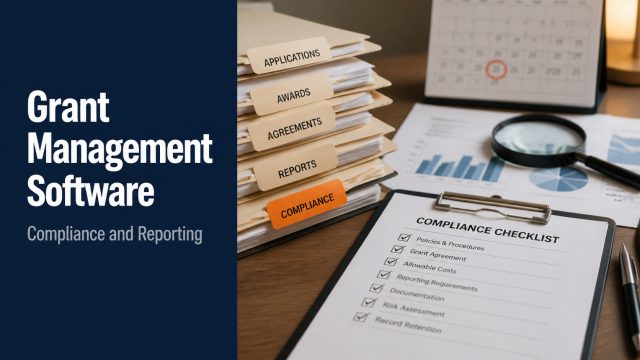
Last researched: September 3, 2026. Prices are in US dollars. This guide covers software for nonprofits seeking and managing grants (the “grantseeker” side) — if you’re a foundation distributing money, most of the tools below aren’t built for you; see the grantmaker note in the tracking section.
Grant management software isn’t really one category. It’s three different jobs that vendors bundle, split and rebrand with confusing regularity: finding funders worth applying to, tracking applications and compliance once you’ve got the money, and — if you run your own sub-grant or scholarship program — reviewing applications from other people. Almost no single tool does all three well, and one of the category’s best-known names for the tracking job, Foundant’s GrantHub, has quietly been discontinued. This guide sorts out which tool solves which problem, what things actually cost, and where the real federal compliance risk sits.
The three jobs grant software actually does
Before comparing products, it’s worth naming the framework, because vendor marketing blurs it constantly. Discovery means finding funders and open opportunities that match your organization — a database and matching problem. Tracking means managing deadlines, post-award compliance, indirect cost allocation and reporting once you have the grant — an operations and audit-trail problem. Application-review workflow means managing applications submitted to you, if your nonprofit re-grants, runs a scholarship fund, or administers a CSR-style program — which is, structurally, a grantmaker’s problem even when a nonprofit is the one buying the software.
| Job | Tools built for it | Who needs it |
|---|---|---|
| Discovery (find funders) | Instrumentl, GrantStation, Candid Foundation Directory Online, GrantWatch | Any nonprofit actively pursuing new grant funding |
| Tracking / compliance | Instrumentl (upper tiers), AmpliFund / Euna Grants, Sage Intacct’s grant tracking module | Orgs managing multiple active awards, especially federal money |
| Application-review workflow | Submittable, Foundant Grant Lifecycle Manager, Fluxx, SmartSimple, Blackbaud Grantmaking | Nonprofits that re-grant, run scholarships, or administer their own award programs |
No tool researched for this guide does all three jobs well. Instrumentl comes closest — discovery plus tracking plus gated AI drafting assistance — but its own application-drafting AI is labeled “beta” at its entry tier, and post-award/accounting-integration features sit behind its most expensive plan.
Finding funders: the discovery tools, compared
Instrumentl is the most fully built-out option, and the most expensive. Its Discover tier starts at $299/month billed annually ($349 month-to-month) for up to three users, scaling to $499/month for Pre-Award pipeline tracking and $999/month for Full Lifecycle post-award and accounting-integration features, plus a custom Enterprise tier. It claims 36,000+ active RFPs and 450,000+ funder profiles, and G2 and Capterra reviewers rate it highly (4.9/5 and 5.0/5 respectively) — but Capterra reviewers specifically flag the pricing as “prohibitive for small nonprofits” even while praising the product itself.
GrantStation is a research-and-education membership rather than workflow software — no pipeline tracking, no application drafting — priced at $699/year (or $219/quarter), covering 150,000+ funder profiles and 15,000+ curated grants plus proposal-writing guides and templates. It’s also resold through nonprofit associations and TechSoup at member rates.
Candid Foundation Directory Online is the oldest and deepest prospect-research database in the category — 140,000+ foundations and corporate donors, 3.8 million recent grants, 500,000+ funder contact records — but Candid doesn’t publish pricing anywhere; TrustRadius states plainly it “does not currently have any pricing plans listed.” Many nonprofits access it through a library or association subscription rather than buying direct.
GrantWatch is the cheapest entry point — $22/week, $49/month, or $249/year for its best-value annual plan — covering 12,000+ human-verified listings. It has restructured its pricing in 2026 around an unusual consumption-credit model: each tier includes a bank of “GrantWatch Intelligence” AI tokens (300K weekly up to 5M annually) for its bundled AI search and writing features, with additional tokens purchasable separately. That’s a real cost-predictability tradeoff worth knowing before you commit — heavy AI users can burn through an allocation faster than expected.
| Tool | Starting price | AI depth | Best fit |
|---|---|---|---|
| Instrumentl | $299/mo (annual) | Beta AI prospecting + gated “Apply Advisor” draft assist | Orgs wanting one platform from discovery through award tracking |
| GrantStation | $699/yr | AI search-term generation only | Small orgs wanting research plus how-to-write guidance, not workflow software |
| Candid FDO | Not published — contact sales | None found | Deep prospect research, often via library/association access |
| GrantWatch | $22/week or $249/yr | AI writing + search, token-metered | Cost-sensitive orgs, occasional applicants |
FREE GUIDE
The Grant Compliance Crisis: Why Nonprofits Struggle — the federal compliance failures auditors flag most often, and what to fix before your next Single Audit.
Foundant’s GrantHub is gone — here’s what changed
If you’ve researched this category before, you may remember Foundant GrantHub as a go-to affordable tracking tool for grantseekers. As of this research pass, it’s discontinued. TrustRadius’s own listing for the product is now titled “Foundant GrantHub, discontinued,” and Foundant’s current grant-management solutions page no longer mentions GrantHub at all — it lists only grantmaker-side products (Grant Lifecycle Manager, GivingData, SmartSimple, CommunitySuite, Scholarship Lifecycle Manager). Foundant’s notice to GrantHub customers states that the company decided to sunset GrantHub and GrantHub Pro on January 31, 2026 so it could focus on the software funders use. GrantHub Pro was still receiving feature investment as recently as May 2024, when Foundant announced a Candid database integration for it, so the shutdown followed soon after active development.
Practically, that means the once-common “Instrumentl vs. Foundant” comparison doesn’t really hold up anymore. Foundant’s remaining flagship, Grant Lifecycle Manager, is built for grantmakers — foundations distributing money — not nonprofits seeking it. If GrantHub was on your shortlist, Instrumentl is now the closest active grantseeker-side alternative, and it’s worth reading that as a market-consolidation signal generally: this is a category where a nonprofit can build real dependency on a tool, and vendor lock-in risk runs both ways.
Tracking and compliance: where the money actually gets managed
AmpliFund, now rebranded and marketed as Euna Grants following its acquisition by Euna Solutions, is the most explicitly compliance-oriented tool in the category. Euna does not publish prices: the old amplifund.com pricing page now redirects to Euna’s Grants page, which asks buyers to request pricing. TrustRadius lists two entry tiers, Grant Seeker Core at $5,000/year and Grant Maker Core at $6,000/year, with Advanced and Enterprise tiers by custom quote and no free version or trial (checked on October 6, 2026). AmpliFund’s marketing names “OMB Uniform Grant Guidance” and the “GREAT Act” directly, the most explicit federal-compliance positioning found anywhere in this category. Reviews are thin — G2 shows only 3.8/5 from 3 reviews — so treat satisfaction data here as low-confidence, but one reviewer’s description of moving “from spreadsheet-based grant tracking to a centralized location” is a useful, concrete before/after.
Submittable is a broader application-intake and review platform — also used for CSR programs, awards and content submissions — with a nonprofit/grants-specific offering. It doesn’t publish pricing; Capterra reviewers flag cost as “higher than alternatives” despite strong overall satisfaction (4.8/5 from 398 reviews, 98% positive). Worth knowing: per Capterra’s own vendor profile, only 29% of Submittable’s user base is nonprofits — 70% are small businesses using it for unrelated submission-management needs. That makes Submittable the one tool in this guide that behaves like general-purpose business software with a nonprofit vertical bolted on, rather than a purpose-built nonprofit tool. Its real strength is the review workflow itself — form building, reviewer collaboration, applicant communication — which is exactly the shape of tool you need if your nonprofit runs its own competitive grant, scholarship or re-granting program, rather than one seeking grants from others.
A note on grantmaker-side tools. Foundant Grant Lifecycle Manager, Fluxx Grantmaker, SmartSimple and Blackbaud Grantmaking are all built for foundations and institutional funders distributing money, not nonprofits seeking it — none publish pricing, and all require a sales conversation. They matter to a grantseeker mainly as “this is probably what your funder’s system looks like,” useful context if you’re troubleshooting a funder portal or trying to understand reporting requirements from their side. One 2026 development worth flagging: Fluxx acquired a company called Grantseeker in November 2025, aiming to eventually serve both sides of the transaction — but Fluxx’s own announcement is explicit that Grantmaker and Grantseeker will run as separate products with dedicated teams for now, so there’s no unified platform to evaluate yet. Fluxx’s letter to customers says logins, data, support and pricing remain as they are, and it lists integration between Grantmaker and Grantseeker as a future priority without giving a timeline. And if you’re coming from our Raiser’s Edge NXT alternatives guide, note that Blackbaud Grantmaking is a completely separate product from Raiser’s Edge — built for funders, not fundraisers — connected only by an optional data connector.
AI grant-writing tools
Grantable is the clearest example of a dedicated AI grant-writing product actually shipping in 2026, rather than an AI feature bolted onto an existing database. Its free tier allows 5 chat messages a day; Starter runs $50/month (50 messages/day) and Pro runs $150/month (200 messages/day), with an Agency Hub add-on at $300/month for consultants managing multiple clients. Nonprofits under $500,000 in annual budget get a one-year discount — $25/month on Starter, $75/month on Pro. Its shipped features include prospecting agents that score funders against Form 990 filings and giving history, automated conversion of RFPs into section-by-section drafting checklists, and a growing content library meant to preserve institutional memory across proposals — useful if your organization has ever lost momentum when a grant writer left. Grantable’s homepage says it is trusted by more than 30,000 grant-seeking organizations, which is the company’s own figure. Independent review data is minimal: its G2 profile shows a single review (checked on October 6, 2026). A separate product sometimes referenced as “Grantboost” could not be confirmed as a real, currently shipping tool distinct from Grantable — treat any reference to it with caution.
Beyond dedicated tools, AI shows up as a bolt-on feature elsewhere: Instrumentl’s “Apply Advisor” assists with application drafting but sits behind its Pre-Award tier and above, and its lower-tier “AI prospecting assistant” is explicitly labeled beta by Instrumentl itself — worth noting since it’s the most AI-marketed tool in the category and still hedges on maturity. GrantWatch bundles AI search and writing assistance into its “GrantWatch Intelligence” branding, metered by the token system described above. GrantStation’s AI is the narrowest of the bunch — it only helps generate better search terms against its own database, not matching or drafting.
Do you already have grant management, if you’re on Sage Intacct or NetSuite?
Possibly, for part of the job. Sage Intacct’s Grant Tracking & Billing capability, covered in more depth in our Sage Intacct for nonprofits guide, centralizes grant documents, flags reimbursable costs at transaction entry, tracks employee effort per grant, handles indirect cost billing by negotiated rate, and supports budget-to-actuals reporting across grant periods that don’t match your fiscal year. That’s real, substantive coverage of the post-award tracking and compliance layer — and notably, it’s the single clearest link found anywhere in this research between a specific software feature (employee effort tracking) and a specific, named audit-finding category (payroll/time-and-effort documentation, discussed below). What it doesn’t do is oddly under-marketed: Sage Intacct’s own page never uses the phrase “Uniform Guidance” or “2 CFR 200,” despite doing work that directly supports it — a real gap between what the software does and how it’s marketed to compliance-anxious buyers.
NetSuite offers nonprofit-specific “Social Impact” editions (Starter, Standard and Donation), covered in our NetSuite for nonprofits guide. According to NetSuite’s documentation, all three editions include the NFP Financials SuiteApp, and the Starter and Standard editions add a dedicated Grant Administrator role (checked on October 6, 2026).
The practical bottom line: if you’re already on Sage Intacct or NetSuite with a grants-capable edition, you likely don’t need a separate post-award tracking tool. But neither platform does funder prospecting — you’ll still want a discovery tool from the section above — and neither handles inbound application review if you run your own sub-grant or scholarship program.
Eight signs you’ve outgrown ad hoc grant tracking
- You’re managing five or more active grants with different reporting cadences or fiscal years that don’t line up with your own.
- Someone on your team has described your current system, out loud, as “the spreadsheet.”
- You’ve missed a deadline, or come uncomfortably close.
- You’re spending federal money and are at or approaching the $750,000-a-year threshold that triggers a Single Audit.
- You can’t currently produce clean documentation for indirect cost allocation or employee time-and-effort per grant — the single most commonly cited failure category in both compliance sources reviewed for this guide.
- Your grant win rate has been flat for a while and nobody can say why.
- You run your own competitive grant, scholarship or re-granting program and are still managing applicant review by email and shared drive.
- Institutional memory walks out the door whenever a grant writer or grants manager leaves.
FREE GUIDE
The Grant Compliance Crisis: Why Nonprofits Struggle — the federal compliance failures auditors flag most often, and what to fix before your next Single Audit.
The federal compliance angle: Uniform Guidance and the Single Audit
If your nonprofit spends federal money, 2 CFR 200 — commonly called “Uniform Guidance” — governs how you document costs, allocate indirect expenses, track staff time against grants, and monitor any subrecipients you pass funds to. Cross the $750,000-a-year threshold in federal expenditures and you’re required to undergo a Single Audit. According to a 2024 GAO report, federal agencies distributed roughly $1.1 trillion in awards in fiscal year 2023 alone, with about 40,000 single audits submitted that year — and, more strikingly, $1.17 trillion of the $6.97 trillion in direct federal awards made between 2017 and 2021 was connected to audit findings the GAO characterized as both severe and persistent, including $69 billion tied specifically to COVID-19 relief funds. [Note: this GAO figure is from an April 2024 report — the most authoritative federal-oversight statistic located, but it predates this article’s 2026 publication and should be read as “as of 2024,” not as a current-year number.]
Two accounting-firm sources reviewed for this guide independently converge on the same failure pattern. A CPA firm’s audit of common Single Audit findings names inconsistent payroll allocation across federal funding sources, weak expense-approval documentation, and missing formal procurement policy (a direct violation of 2 CFR 200.318) among the most recurring problems. A second firm’s breakdown of standard OMB compliance-supplement deficiency categories explicitly calls out “inadequate payroll documentation and inconsistent indirect cost application” — and sums up the underlying discipline required in five words: “If it isn’t documented, it didn’t happen.” Both sources agree auditors are checking for consistent process and paper trail, not any single “correct” methodology.
Software helps with the documentation and audit-trail mechanics — Sage Intacct’s per-grant effort tracking and AmpliFund’s explicit Uniform Guidance framing are the two clearest examples found in this category — but it doesn’t replace the underlying policy work: adopting a written procurement policy, negotiating an indirect cost rate, and building real subrecipient-monitoring procedures are organizational commitments software can support, not substitute for.
Cost comparison
| Tool | Job | Starting price |
|---|---|---|
| GrantWatch | Discovery | $22/week or $249/yr |
| GrantStation | Discovery + education | $699/yr |
| Grantable | AI drafting | Free tier; $50/mo Starter ($25/mo nonprofit rate) |
| Instrumentl | Discovery + tracking + AI | $299/mo (annual) |
| Candid FDO | Discovery | Not published — contact sales |
| AmpliFund / Euna Grants | Tracking + compliance | $5,000/yr (Grant Seeker Core, per TrustRadius; vendor quotes only) |
| Submittable | Application review | Not published — contact sales |
This category leans harder on “contact sales” pricing than the donor-CRM or accounting tools covered elsewhere in this cluster — worth budgeting extra time for quote conversations if transparent pricing matters to your selection process.
Frequently asked questions
What’s the best grant management software for small nonprofits?
For discovery on a tight budget, GrantWatch ($22/week or $249/year) or GrantStation ($699/year) are the lowest-cost entry points. If you want workflow and tracking too, Instrumentl’s Discover tier starts at $299/month — materially more expensive, and Capterra reviewers explicitly call the price “prohibitive for small nonprofits” despite otherwise strong satisfaction. Foundant’s former grantseeker option, GrantHub, is no longer available, which is a real gap in the affordable end of the tracking-software market right now.
Do I need separate grant management software if I already have Sage Intacct or NetSuite?
Partially no, for the post-award and compliance layer — Sage Intacct’s grant tracking module and NetSuite’s nonprofit-specific editions both handle real pieces of that work natively. But neither replaces a discovery tool for finding funders, and neither handles inbound application review if you run your own sub-grant or scholarship program.
How much does grant management software cost?
It depends entirely on the job. Discovery-only tools run roughly $249 to $3,600-plus a year. AI grant-writing assistance runs from free to about $1,800 a year. Dedicated tracking and compliance platforms are mostly quote-only, including AmpliFund/Euna Grants, which third-party estimates put at $5,000–$6,000-plus a year.
What is Uniform Guidance, and does software actually help with it?
2 CFR 200, known as Uniform Guidance, governs how nonprofits receiving federal funds must document costs, allocate indirect expenses, track staff time against grants, and monitor subrecipients — and noncompliance surfaces in a Single Audit, required above $750,000 a year in federal spending. Software helps with the documentation and audit-trail mechanics but doesn’t replace the underlying policy work of adopting written procedures in the first place.
Instrumentl vs. Foundant, which is better?
They’re not really direct competitors anymore. Instrumentl is an active discovery-through-tracking platform for nonprofits seeking funding. Foundant’s grantseeker product, GrantHub, has been discontinued, and its remaining flagship, Grant Lifecycle Manager, is built for grantmakers distributing money, not nonprofits seeking it. If you’re a grantseeker, Instrumentl is the one still actively serving your side of the transaction.
Sources
- Instrumentl, pricing. Vendor.
- Instrumentl, nonprofit case studies. Vendor.
- G2, Instrumentl reviews. Review platform.
- Capterra, Instrumentl reviews. Review platform.
- GrantStation, membership pricing. Vendor.
- Candid, Foundation Directory Online. Vendor.
- TrustRadius, Candid Foundation Directory Online pricing. Review platform.
- GrantWatch, plans and pricing. Vendor.
- Foundant, grant management solutions. Vendor.
- TrustRadius, Foundant GrantHub (discontinued). Review platform.
- Foundant, Grant Lifecycle Manager. Vendor.
- G2, Grant Lifecycle Manager reviews. Review platform.
- Submittable, nonprofit solutions. Vendor.
- Capterra, Submittable profile and reviews. Review platform.
- AmpliFund, grant management software. Vendor.
- TrustRadius, AmpliFund pricing. Review platform.
- G2, AmpliFund reviews. Review platform.
- Fluxx, Fluxx acquires Grantseeker. Vendor, dated 2025-11-12.
- G2, Fluxx Grantmaker reviews. Review platform.
- Capterra, SmartSimple Cloud reviews. Review platform.
- Blackbaud, Blackbaud Grantmaking. Vendor.
- G2, Blackbaud Grantmaking reviews. Review platform.
- Grantable, AI grant writing. Vendor.
- Sage Intacct, grant tracking and billing. Vendor.
- The Charity CFO, Single Audit findings. CPA firm, dated 2025-07-16.
- GRF CPAs & Advisors, strengthening compliance. CPA firm, dated 2025-09-22.
- GAO-24-106173, single audit oversight. U.S. Government Accountability Office, dated 2024-04-22.