

Browse Business Software Categories
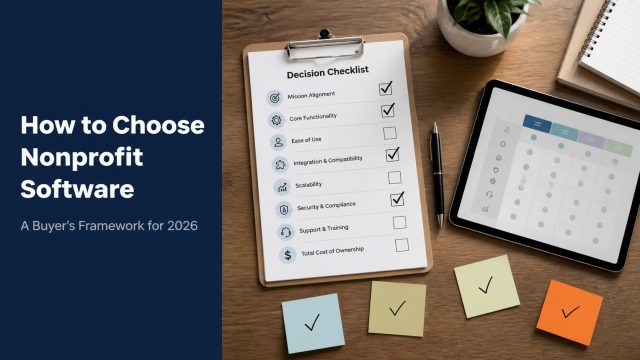
How to Choose Nonprofit Software, A Buyer’s Framework for 2026
Last researched: September 3, 2026. This is the capstone piece in our nonprofit software cluster — for category-specific pricing and vendor comparisons, see our guides to accounting software, donor management software, grant management software, and our pricing hub.
Every guide in this cluster answers a version of “which vendor should I pick.” This one answers a different, more upstream question: how do you run a selection process that doesn’t waste six months and land you with the wrong system anyway? The best sourced material we found on this comes not from software vendors but from vendor-agnostic nonprofit technology consultancies — organizations that make their living helping nonprofits avoid exactly the mistakes this guide covers.
A defensible selection process
The most complete, nonprofit-specific selection sequence we found comes from Build Consulting, a technology consultancy that states plainly it doesn’t partner with any software vendor. Their process, synthesized across several of their published pieces: know your goals first — even a simple three-paragraph roadmap before you start shopping; look broadly at the market before narrowing, so you understand what’s actually available rather than anchoring on the first product you saw; refine your requirements by interviewing stakeholders and focusing on business outcomes rather than feature checklists; run a request-for-proposal process to five to seven providers with a four-to-six-week response window; narrow to two or three finalists for scripted demos anchored to your actual requirements, not vendor-generic walkthroughs; verify that claimed features exist today rather than on a roadmap; and judge cost on a three-to-seven-year total-cost-of-ownership basis, not year-one licensing. Their own summary line is worth repeating directly: don’t rush, but don’t skip steps — especially for CRM- or ERP-class systems that sit at the center of how your organization operates.
A companion piece from the same consultancy argues that four things need to be right before a nonprofit even opens a vendor conversation: leadership (does the purchase connect to actual strategy), operations (do you have project-management and change-management capacity, and have you budgeted total cost of ownership, not just license cost), process (do you actually understand how your organization works today), and data (is what you have clean and complete enough to migrate). Their framing, worth quoting directly: get everything right upstream of the technology itself, and selecting and implementing the right software becomes far easier.
Common mistakes, and what they actually cost
The best-documented account of what goes wrong comes from the same consultancy’s “five perils of rushing” framing: incomplete requirements that surface later as implementation failure (missing reports, poor integrations, insufficient licenses); lack of stakeholder buy-in, since a technology change is inherently an organizational change and skipping consultation during selection undermines cooperation during rollout; increased staff turnover, since a rushed, poorly-fit system compounds the stress that implementation already puts on the team; damage to constituent relationships, when a badly-fit system degrades donor- or volunteer-facing processes; and reputational damage for systems that are direct constituent touchpoints.
A specific, concrete pattern worth knowing before you enter a sales conversation: overbuying licenses. One consultancy names two vendors specifically — Salesforce.org and Blackbaud — as pressuring nonprofits toward full up-front license commitments even though SaaS pricing is theoretically scalable, citing real (if anecdotal) examples: one organization sold 500,000 constituent records when it needed fewer than 1,000 for an eight-month implementation window, another sold 50 user licenses when 15 months of work required only 10. Two specific sales tactics to recognize: the claim that full commitment upfront is “how everyone does it,” and artificial quarter-end discount deadlines that are, per the same source, typically negotiable rather than fixed.
A field example from a nonprofit practitioner, writing for NTEN in May 2026 about choosing a mobile messaging vendor, captures a subtler mistake: comparing vendors “on their terms instead of mine.” Her specific traps: not building an evaluation framework before starting vendor conversations, so incompatible pricing models (per-message, per-segment, credit-based) made bids impossible to compare directly; not accounting for message-length billing quirks that can triple real-world cost; and underestimating how poor internal contact-data quality would affect both cost and setup. Her fix — a weighted scorecard applied consistently across every vendor, covering pricing, support, technical integration, compliance and performance — is a portable tool for any category in this cluster.
FREE GUIDE
AI Playbook for Nonprofits — where AI actually fits in your technology stack, and how to evaluate it without the hype.
How AI is changing nonprofit software buying in 2026
We want to be honest about what does and doesn’t exist here. NTEN, partnering with the Bridgespan Group, is fielding a flagship “State of Nonprofit AI” survey — but it doesn’t launch until September 10, 2026, and as of this guide’s research date, no results exist yet. If you see a confident sector-wide “X% of nonprofits use AI” statistic circulating right now, treat it with real skepticism until that survey publishes.
What we do have is real, dated evidence at a smaller scale. Fast Forward, a nonprofit tech accelerator, fielded a 2025 “AI for Humanity Report” (reported by the Chronicle of Philanthropy) that found real momentum inside its own applicant pipeline — self-identified “AI-powered” applicants grew from 13 of 247 in 2024 to roughly 124 of 247 in 2025 to 379 of 782 in 2026 — but that’s a self-selected accelerator-seeking cohort, not a representative sample of the sector. Among nearly 200 respondents describing themselves as AI-powered: 40% had used AI for a year or less, nearly half reported AI adoption increased their expenses rather than saving money outright, and 78% described their use as “assisted” — general tools like ChatGPT or Gemini for back-office tasks — rather than purpose-built AI products. Nearly half cited data-privacy risk as a real concern, and over three-quarters said their AI use relies on public datasets for model training, a specific data-governance detail worth asking your own vendors about directly.
Concretely, nonprofits reported using AI for grant-application drafting (one organization, Pets for Patriots, estimated an 80–90% cut in drafting time and won a $30,000 grant using AI-assisted drafting), donor prospect research (prospect reports generated in under five minutes versus hours manually), and matching algorithms narrowing large candidate pools down to a handful of viable options for mentee-volunteer or housing-placement programs. A separate Chronicle of Philanthropy piece profiled AI “virtual engagement officers” deployed across roughly 50 institutions, raising about $2 million between October 2024 and July 2025, with a notably low donor opt-out rate of 0.1% — though staff anxiety about job displacement was reported as a real, persisting concern even where the tool worked well, and one institution’s lesson learned was explicitly about bringing the team along on the technology rather than just deploying it.
On evaluating AI specifically as part of a purchase decision, two nonprofit-specific frameworks stood out. One consultancy’s five-point framework: evaluate value across mission impact, constituent experience and financial terms; check technical and data feasibility first, since fragmented data limits AI’s value “regardless of potential value”; assess risk (bias, privacy, legal, operational reliability); count total cost of ownership including staff time for adoption and governance, not just licensing; and plan for the change impact on staff roles and workflows. A second, from Tech Impact, frames it more simply around four questions: is the tool transparent about how it works, does it protect organizational and beneficiary data, is it accessible across a diverse staff on a nonprofit budget, and does it actually align with mission goals rather than being AI for its own sake. A practitioner writing for NTEN in August 2026 offered perhaps the sharpest test of all, applicable directly to any AI feature a vendor tries to sell you: would your leadership be comfortable explaining, to the specific person affected, exactly what data went into the tool and how the result was used? If not, that’s a real answer, not a hypothetical one.
RFP practices worth borrowing
There’s no single standard nonprofit RFP template — that’s worth saying plainly rather than implying otherwise. What the process guidance above converges on: send your request to five to seven providers with a four-to-six-week window and a structured Q&A period, narrow to two or three finalists for demos, and evaluate everything on a multi-year total-cost-of-ownership basis rather than a first-year quote. Beyond process mechanics, a few specific things are worth putting in writing as explicit RFP or contract terms, even though we couldn’t find a single nonprofit-specific named checklist that lists them together: license-scaling terms (get the vendor’s phased-licensing model in writing rather than accepting a full up-front commitment), data storage and integration architecture, and whether a cited feature exists in the shipped product today versus only on a public roadmap.
On the data-security side, general FTC guidance for businesses translates cleanly into RFP questions worth asking any software vendor handling donor or beneficiary data: what are your data security practices, will you commit to a stated standard in the contract rather than just verbally, and what is your breach-notification obligation and timeline. One useful, non-obvious point for nonprofits specifically: California’s Attorney General’s own guidance states plainly that the CCPA — the country’s most prominent state privacy law — generally does not apply to nonprofit organizations. That means for most U.S. nonprofits, contract language with your software vendor, not statute, is your primary lever for protecting donor and beneficiary data. Other states take a different approach. Colorado’s privacy law has covered nonprofits that meet its data-volume thresholds since July 1, 2023, and Oregon’s has applied to nonprofits since July 1, 2025, so check the law in each state where you hold donor or beneficiary data.
One platform, or several?
This question sits directly underneath the whole structure of this cluster — accounting/ERP (covered in our accounting, Sage Intacct and NetSuite guides) and donor CRM (donor management, Raiser’s Edge alternatives) are different jobs, not two flavors of the same software. One consultancy frames it well: your development team needs a CRM that prioritizes modern digital engagement, donor journeys and flexibility; your finance team needs an ERP that prioritizes forecasting, reporting and approval workflows. Their explicit warning: don’t force a CRM to do complex accounting work — it creates untrustworthy data, and when finance stops trusting development’s numbers (or the reverse), that’s a sign you need a structural fix, not a better spreadsheet bridging the two systems.
On platform consolidation specifically — folding more functionality into one system, the way NetSuite or Salesforce can — the case for it is real: a bigger platform can connect business processes into one coherent environment and benefits from a larger integration ecosystem and talent pool. But the same source’s explicit caveat matters just as much: consolidating onto one platform without matching organizational change management can leave an organization “drowning in an over-engineered system that is complex and unusable” — platform consolidation is its own failure mode when it outruns the organization’s actual readiness, echoing the same change-management theme from the mistakes section above.
Red flags when evaluating a vendor
- Pressure to commit to a full license or seat volume immediately, framed as “how everyone does it” — a specific, named tactic used in Salesforce.org and Blackbaud sales processes, per Build Consulting’s own account.
- Artificial urgency via quarter-end discount deadlines that are typically negotiable, not fixed.
- Demos that lean on extra features and polish rather than addressing your stated core requirements — a documented sign the vendor doesn’t have a strong answer to your actual needs.
- Generic “best practice” implementation approaches that force your organization’s workflow into a boilerplate template rather than adapting to how you actually operate.
- Features described as available that only exist on a public roadmap, not in the product you’d actually be buying today.
- A vendor unwilling to put security standards or breach-notification commitments in writing in the contract.
- An implementation partner whose business model depends on selling more of one platform’s licensing — worth asking directly how a partner is compensated, since that incentive may not align with your actual needs.
We didn’t find a nonprofit-specific source naming “won’t provide references” or “unclear data export terms” in so many words, though both are reasonable, common-sense red flags worth applying regardless.
FREE GUIDE
AI Playbook for Nonprofits — where AI actually fits in your technology stack, and how to evaluate it without the hype.
Which category do you actually need first?
This is our own synthesis, built on the cluster’s structure and two anchor points above — not a single external source’s decision tree.
- Do you receive and spend federal award dollars, directly or as a subrecipient? If yes, federal Uniform Guidance (2 CFR 200.302) sets a real regulatory floor for your financial management system’s capability to track, report and document costs per award. That points first toward the accounting/ERP track, even ahead of CRM improvements — the consequence of failing this bar isn’t weaker donor engagement, it’s audit findings. See our grant management software guide for the compliance detail.
- Is your primary pain point donor or volunteer relationship tracking, communication, or fundraising performance? If the federal-compliance bar above isn’t a live concern, the CRM/donor-management track is the more urgent fix — don’t try to solve a relationship-management problem by upgrading your accounting system either.
- Is grant volume and complexity — multiple funders, multiple reporting cycles, subgranting — the actual bottleneck, separate from fund accounting itself? A dedicated grants management layer may be the right next investment, typically sitting on top of, not instead of, whichever accounting and CRM systems you already run.
- Is the honest answer “we don’t know, things just feel broken”? Then the first purchase shouldn’t be software at all — it should be the needs-assessment step itself, internally or through a consultancy. Software selected before that diagnostic step is the single most consistently cited failure mode in everything we researched for this guide.
Frequently asked questions
Is there a standard nonprofit RFP template we should use?
No single, universally-adopted template exists, despite how often the idea is implied. What does exist is consistent process guidance: send requests to five to seven vendors, allow four to six weeks for responses, narrow to two or three finalists for demos, and evaluate on multi-year total cost of ownership rather than year-one price.
Should we consolidate onto one platform or use separate best-of-breed tools?
It depends on whether your organization has the change-management capacity to match the consolidation. A single platform can create a more coherent environment and a larger integration ecosystem, but consolidating without matching organizational readiness is its own documented failure mode. Forcing a CRM to do accounting, or an ERP to do relationship management, tends to produce untrustworthy data either way.
How much should AI features factor into our decision right now?
Enough to ask the right questions, not enough to chase hype. No sector-wide adoption survey exists yet to benchmark against — NTEN and Bridgespan’s flagship survey doesn’t launch until September 10, 2026. Evaluate AI features the way you’d evaluate any other feature: does your underlying data support it, do you understand what data goes into the tool, and would you be comfortable explaining that use to the person it affects.
What’s the single most common reason nonprofit software selections go wrong?
Rushing past requirements-gathering and stakeholder buy-in. Every source we found on documented selection failures traces back to this in some form — incomplete requirements, a decision made without cross-functional input, or software chosen before the organization actually understood its own needs.
Sources
- Build Consulting, 10 tips for selecting nonprofit software. Nonprofit tech consultancy, 2020.
- Build Consulting, technology comes last. Nonprofit tech consultancy, 2018.
- Build Consulting, 9-step CRM selection strategy. Nonprofit tech consultancy, 2022.
- Build Consulting, guiding the demo process. Nonprofit tech consultancy, 2019.
- Build Consulting, the art of technology selections. Nonprofit tech consultancy, 2023.
- Build Consulting, five perils of rushing selections. Nonprofit tech consultancy, 2021.
- Build Consulting, avoiding license overbuying. Nonprofit tech consultancy, 2018/2023.
- Build Consulting, the platform-centric nonprofit. Nonprofit tech consultancy, 2020/2026.
- Build Consulting, buy or build on Salesforce. Nonprofit tech consultancy, 2020/2026.
- Build Consulting, CRM or ERP. Nonprofit tech consultancy, 2026.
- Build Consulting, strategic framework for nonprofit AI investment. Nonprofit tech consultancy, 2025.
- NTEN, four questions before your nonprofit automates. Practitioner, American Red Cross, 2026.
- NTEN, choosing a mobile messaging vendor. Practitioner, BRAC USA, 2026.
- NTEN, State of Nonprofit AI survey. NTEN and Bridgespan Group, launching September 2026.
- Tech Impact, choosing the right AI tool. Nonprofit tech consultancy, 2026.
- Bridgespan Group, responsible data, AI and technology strategy. Nonprofit strategy consultancy.
- Chronicle of Philanthropy, nonprofits embracing AI. Independent journalism, 2025.
- Chronicle of Philanthropy, nonprofits turning to AI to save time and money. Independent journalism, 2025.
- Chronicle of Philanthropy, can AI raise money and not replace humans. Independent journalism, 2025.
- FTC, protecting personal information, a guide for business. U.S. Federal Trade Commission, 2016.
- California Attorney General, CCPA guidance. State government.
- 2 CFR 200.302, financial management system standards. Electronic Code of Federal Regulations.