

Distribution
ERP
Warehouse Management
Warehouse Slotting Software: When You Need It and What It Does

Last updated: October 7, 2026 · Independent buyer’s guide · We do not sell rankings or coverage.
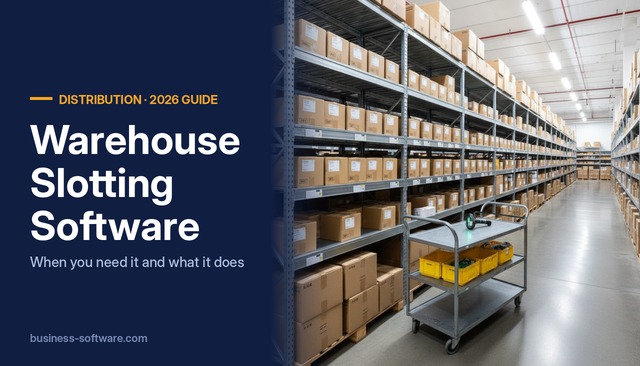
Warehouse slotting software decides which pick location each SKU should live in, based on how often it is picked (velocity), how much space it uses per period (cube movement), how heavy it is, and which items ship together. You need it when your pick faces were set up years ago, your SKU count or order mix has changed, and pickers walk past slow movers to reach fast ones. Most mid-market distributors can start with the slotting tools inside their WMS or ERP; a dedicated slotting tool earns its cost in larger, high-volume buildings where the move list itself becomes the hard part.
Key takeaways
- Slotting combines four inputs: pick frequency, cube movement, weight and item affinity. Velocity alone mis-sizes bulky fast movers.
- Published, measured gains are smaller than vendor headlines. Smart & Final reported over 10% less pick-path travel and a 2% to 3% gain in DC selecting productivity after an Optricity re-slot (Food Logistics, 2010).
- WMS-native slotting (Dynamics 365 Supply Chain Management, SAP EWM, Manhattan Active WM) handles rule-based assignment. Dedicated tools (FORTNA OptiSlot DC, Lucas Dynamic Slotting, Optioryx Pulse) add move-list prioritization and what-if modeling.
- None of the dedicated slotting vendors we reviewed publishes a price. Budget for a quote, plus the labor to physically move product.
- Re-slot when your pick profile shifts, not on a fixed calendar. Vendors describe periodic full resets plus small, frequent maintenance moves.
What slotting is and why pick faces drift out of position
A good slot puts each SKU where a picker reaches it with the least travel and bending, in a location sized so it does not need constant replenishment.
Pick faces drift out of position because the business changes faster than the layout. New SKUs go wherever a bin is open and seasonal items stay in prime slots after the season ends. Smart & Final’s Commerce, California DC is a documented example: built in 1999, it had absorbed 3,000 low-velocity items and lost 325 fast movers to another facility over ten years before the company re-slotted it (Food Logistics, September 28, 2010).
The cost shows up in picker travel and in mis-picks when look-alike items sit side by side. Our analysis of what mis-picks really cost distributors covers the downstream cost.
The four inputs: velocity, cube, weight and affinity
Velocity (pick frequency)
Velocity is the number of pick lines or visits a SKU receives in a period, not the number of units shipped. A SKU picked 400 times a month in ones needs a better slot than one picked 20 times in cases of 50. SAP documents an ABC analysis in S/4HANA EWM slotting that ranks products by confirmed warehouse task frequency, which is a pick-visit measure (SAP Learning, no date shown).
Cube movement
Cube movement is units picked per period multiplied by the unit’s volume. It tells you how much space a SKU consumes over a replenishment cycle, which decides the slot size. Two items with the same velocity can need a half-shelf and a full pallet position. Sizing slots by cube movement is how you control replenishment trips.
Weight and ergonomics
Heavy items belong near waist height and early in the pick path. The NIOSH lifting equation sets a load constant of 23 kg (about 51 lb) under ideal conditions (CCOHS, last revised April 27, 2021). CCOHS’s multiplier table gives the highest vertical multiplier at about 70 cm (roughly 28 inches) of hand height, falling to 0.78 at floor level and 0.70 at 175 cm (CCOHS, last revised April 26, 2023). That band is the basis of the “golden zone”, roughly knee to shoulder height, which you reserve for your fastest and heaviest items.
Affinity and separation rules
Affinity means placing items that are frequently ordered together near each other. Separation rules do the opposite: they keep look-alike items, food and chemicals, or incompatible hazmat apart. Smart & Final used its re-slot to create a separate pick path for hazardous materials away from food (Progressive Grocer, no date shown).
Measured pick-path gains: what the evidence shows
Most published slotting results come from vendors. The table separates measured, modeled and vendor-claimed figures.
| Source | Setting | Reported result | Type of evidence |
|---|---|---|---|
| Smart & Final with Optricity (Food Logistics, 2010) | 480,000 sq ft grocery DC, Commerce, CA | Over 10% less pick-path travel; 2% to 3% selecting productivity (over $100,000 a year); $300,000 a year in store labor | Implemented, customer-reported, published via vendor case study |
| MIT CTL capstone, Kunduru and Rastogi (2025) | Newell Brands baby gear unit, Neosho DC | Estimated 24% reduction in travel distance from order-oriented slotting | Modeled, not implemented |
| FORTNA World Slotting Day deck (2024) | Anonymized clients | Travel reductions of 10% to 23%; 10% productivity in manual picking | Vendor-reported |
| Lucas Systems release (2024) | Not specified | 5% to 20% productivity; 10% to 20% labor cost savings | Vendor claim, not attributed to a named customer |
Implemented re-slots show travel reductions of around 10%, with larger figures in models and selected case studies. Productivity gains are smaller because travel is only part of pick time, so build your business case on the lower figures.
How the re-slotting process works step by step
- Clean the item master. Wrong case and each dimensions and weights make slotting output unusable.
- Profile demand. Pull 6 to 12 months of order lines and calculate pick visits, cube movement and co-occurrence by SKU, adjusted for seasonality.
- Define locations and constraints. Record each slot’s dimensions, weight capacity, height band and zone, plus separation rules. The software then assigns each SKU to a location.
- Turn the plan into a move list. This step separates tools. You want moves ranked by benefit and sequenced to avoid double handling.
- Execute and update the WMS. Smart & Final moved 6,892 pallets in one weekend using 783 labor hours at a cost of $25,000 (Food Logistics, September 28, 2010). Update location records and min/max values in the same window.
Re-slotting cadence
No standards body sets a re-slot frequency. FORTNA’s 2024 deck describes periodic resets plus minimal maintenance moves (FORTNA, October 22, 2024). Optioryx, which sells a slotting tool, suggests triggering a re-slot when your top 20% of SKUs account for a meaningfully different share of picks than at the last re-slot (Optioryx, updated September 30, 2026). A practical approach is to review velocity rankings monthly, slot new items as they arrive, and do a full reset before peak season.
Where slotting projects go wrong
The common failures are wrong dimension data, which mis-sizes slots; velocity-only ranking, which lets bulky fast movers fill the golden zone; plans that move every SKU when a small share of moves delivers most of the benefit; and min/max levels left unchanged after slot sizes change. Concentrating every fast mover in one aisle also cuts travel on paper and creates queues on the floor.
How software handles slotting: WMS-native vs dedicated tools
WMS and ERP-native slotting
Microsoft Dynamics 365 Supply Chain Management has a documented warehouse slotting feature. It consolidates demand from sales orders, transfer orders or outbound shipment orders, locates that demand against location directives, and creates replenishment work, and it can run on a recurring schedule (Microsoft Learn, May 29, 2026). It assigns stock to pick locations before order release; it is not a velocity, cube and affinity optimizer with move ranking, and a generated plan cannot be edited.
SAP S/4HANA EWM slotting uses product, packaging, storage requirement and demand data, including dimensions and weight, to set putaway control indicators, maximum quantities, storage sections and bin types, saved as planned or active values, with machine-learning proposals for new products (SAP Learning, no date shown). It needs EWM expertise to configure.
Manhattan Active Warehouse Management offers slotting optimization that a Manhattan partner, Everest, describes as using velocity, cube, weight and item affinity to generate directed re-slot tasks inside the WMS (Everest, no date shown). Everest sells Manhattan implementation services.
Oracle NetSuite WMS documents rule-based pick and putaway strategies prioritized by sequence number (Oracle NetSuite Help, no date shown). We did not find a velocity-based re-slotting optimizer in the NetSuite documentation we reviewed, so plan on a spreadsheet or third-party analysis feeding putaway rules. Our warehouse management software research center lists the main WMS options if you are still choosing.
Dedicated slotting tools
FORTNA OptiSlot DC came from Optricity, which FORTNA acquired in February 2022 (Supply Chain Management Review, February 14, 2022). FORTNA’s product page claims a 10% productivity gain, 40% damage reduction and 12% fewer replenishment moves, and publishes no pricing (FORTNA, no date shown).
Lucas Systems Dynamic Slotting uses machine learning to rank moves by payback, considers seasonality, item dimensions, velocity and pick paths, and keeps similar items apart to reduce picking errors (Lucas Systems, July 16, 2024). Pricing is not published.
Optioryx Pulse runs on top of an existing WMS, either standalone or through an API, and Optioryx says pricing depends on warehouse count, volume, the modules selected and integration type (Optioryx, updated September 30, 2026).
| Approach | Examples | Strengths | Limitations |
|---|---|---|---|
| Spreadsheet ABC analysis | Excel plus WMS export | No license cost; fine for a few thousand SKUs | Manual move lists; affinity and cube are hard to model |
| ERP or WMS rules | NetSuite WMS, Dynamics 365 SCM | Assignments flow straight into putaway and replenishment work | Limited optimization and what-if modeling |
| Tier-one WMS slotting module | SAP EWM, Manhattan Active WM | Uses dimensions, weight and demand; directed re-slot tasks | Configuration effort; tied to that WMS |
| Dedicated slotting tool | FORTNA OptiSlot DC, Lucas Dynamic Slotting, Optioryx Pulse | Move ranking by benefit, scenario testing, works across WMSs | No published pricing; needs data integration |
What it costs
None of the dedicated slotting vendors we reviewed publishes list prices, and WMS-native slotting is bundled into WMS licensing, so you will need quotes. Smart & Final’s documented figure of $25,000 for 6,892 pallet moves works out to roughly $3.63 per pallet moved, at 2010 labor rates. Add internal time to clean item dimensions.
Worked example
Illustration: all figures below are constructed for this example and are not from a real company. A distributor runs 8 full-time case and each pickers for 250 days a year at 6.5 productive hours a day, which is 13,000 picking hours. Assume travel is half of pick time, or 6,500 hours, and the loaded labor rate is $28 an hour.
If a re-slot cuts travel by 10%, in line with the Smart & Final result, the saving is 650 hours, or $18,200 a year. If the re-slot moves 1,200 SKUs at 6 minutes each, that is 120 labor hours, or $3,360, plus about 80 hours of analyst time. On these assumptions a spreadsheet or WMS-native re-slot pays back within a few months. A dedicated tool must add replenishment or multi-site savings to justify its license.
Our independent take
For most US distributors with one or two buildings, the first gain comes from accurate item dimensions and a disciplined velocity and cube review, not from a new product. Use the slotting functions in your WMS or ERP first and measure travel before and after. Consider a dedicated tool for tens of thousands of pick faces, frequent assortment change, several sites, or a WMS without slotting. Ask every vendor for a named reference with before-and-after travel data.
Buyer scenarios
Industrial supply distributor, 6,000 SKUs, one 120,000 sq ft building on NetSuite WMS. Export 12 months of pick lines, rank by visits and cube, and re-slot the top 300 SKUs into the golden zone near the dock. Update putaway rules and measure lines per hour for a month before buying anything.
Food service distributor, 15,000 SKUs, three DCs on Dynamics 365 Supply Chain Management. Use the native warehouse slotting templates to keep forward pick locations filled ahead of wave release, and set a recurring run. For cross-site what-if modeling, pilot a dedicated tool on one DC and compare replenishment counts.
Multi-site retail and e-commerce DC, 60,000 active SKUs, Manhattan or SAP EWM. Manual move lists will not keep up. Configure the WMS slotting module fully before buying a separate tool, then test a dedicated optimizer side by side against it.
When you do not need dedicated slotting software
You probably do not need a separate slotting product if you have fewer than a few thousand active SKUs, a stable assortment, or a small team where one supervisor knows every location. A quarterly spreadsheet review of pick visits and cube captures most of the benefit. Slotting will not fix poor inventory accuracy. If you are still on paper picking with no bin locations, put a WMS in place first; our guide to the key features of distribution software covers what to look for.
How we researched this
We reviewed the top-ranking pages for “warehouse slotting software”, mostly vendor pages, then read Microsoft, SAP and NetSuite documentation, FORTNA, Lucas and Optioryx materials, an MIT study, the Smart & Final case study and NIOSH guidance via CCOHS, all checked on October 7, 2026. We have no commercial relationship with any vendor named.
Frequently asked questions
How often should a warehouse re-slot?
There is no industry standard. Most operations re-slot new and changed items weekly or monthly and do a full reset when the pick profile has shifted significantly, often before peak season. Trigger a review when your top SKUs by pick visits change noticeably.
What is the golden zone in a warehouse?
The golden zone is the shelf height band between roughly knee and shoulder height, where picking needs the least bending; NIOSH guidance via CCOHS peaks at about 70 cm of hand height. Reserve this zone for your fastest and heaviest items.
How much does slotting reduce travel time?
One implemented case, Smart & Final with Optricity, reported over 10% less pick-path travel and a 2% to 3% productivity gain. Modeled studies show more, such as an estimated 24% at Newell Brands in an MIT capstone. Plan on the implemented figure.
Does my WMS already do slotting?
Dynamics 365 Supply Chain Management, SAP EWM and Manhattan Active WM document slotting functions. We found no velocity-based re-slotting optimizer in NetSuite WMS documentation.
What does slotting software cost?
FORTNA, Lucas Systems and Optioryx do not publish pricing, and WMS slotting modules are priced inside the WMS license. Request quotes and budget separately for the labor to move product and clean item dimensions.
Sources
- Food Logistics, Slotting Solution Pays Off for Smart & Final, September 28, 2010 (Optricity case study). foodlogistics.com
- Progressive Grocer, Smart & Final Boosts Supply Chain Efficiency With Slotting Software, no date shown. progressivegrocer.com
- MIT Center for Transportation & Logistics, Kunduru and Rastogi, Minimizing Picker Travel Distance through Inventory Slotting Optimization, May 1, 2025. ctl.mit.edu
- CCOHS, NIOSH Lifting Equation: Assessing Relevant Handling Factors, last revised April 27, 2021. ccohs.ca
- CCOHS, NIOSH Lifting Equation: Calculating Recommended Weight Limit, last revised April 26, 2023. ccohs.ca
- Microsoft Learn, Warehouse slotting (Dynamics 365 Supply Chain Management), May 29, 2026. learn.microsoft.com
- SAP Learning, Performing Slotting (S/4HANA EWM), no date shown. learning.sap.com
- Oracle NetSuite Help, Warehouse Management Strategies, no date shown. docs.oracle.com
- Everest (Manhattan partner, sells implementation services), Manhattan Active Slotting Optimization, no date shown. everesttech.com
- FORTNA (vendor), OptiSlot DC product page, no date shown. fortna.com
- FORTNA (vendor), World Slotting Day 2024 webinar deck, October 22, 2024. fortna.com
- Supply Chain Management Review, Fortna announces acquisition of Optricity, February 14, 2022. scmr.com
- Lucas Systems (vendor), AI-powered Dynamic Slotting release, July 16, 2024. lucasware.com
- Optioryx (vendor), Slotting Optimization Software Comparison Guide, updated September 30, 2026. optioryx.com
Related guides
- Cycle Counting Software: Methods, Frequency and Tools
- Kitting Inventory: How ERP Handles Kits and Bundles
- Cross-Docking Software: How Distributors Run Flow-Through Operations

Sherman Hsieh
Independent analysis of enterprise software — ERP, CRM and more