

Enterprise Content Management
What is Enterprise Content Management Software?

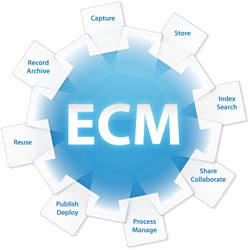
Enterprise content management (ECM) is the set of strategies, methods, and software a business uses to capture, store, organize, secure, and deliver its unstructured content, from documents and PDFs to emails, forms, and scanned records. In short, ECM brings order to the mountain of files a company creates every day, so the right people can find the right information and the business stays compliant.
The idea is older than software. Just as a CRM is the modern version of the Rolodex, ECM is the modern version of the filing cabinet and records room, scaled to the volume of digital content a business now produces. This guide explains what ECM software does, the benefits it delivers, how the category has evolved, and the leading platforms in 2026.
What ECM software actually does
A business runs on content: internal documents, customer-facing forms, manuals, contracts, emails, and files scattered across shared drives. Most of it is unstructured data, meaning it does not live neatly in a database. ECM software captures that content, stores it centrally, indexes it so it is searchable, controls who can access it, and moves it through defined workflows. The result is a single source of truth for your documents instead of a dozen disconnected folders and inboxes.
The benefits of ECM
The research body AIIM has long described the value of ECM in four categories, and the framework still holds:
- Compliance: Organizations that handle large volumes of documents face real regulatory exposure, from Sarbanes-Oxley to GDPR and industry-specific rules. Strong record keeping, audit trails, retention policies, and standardization make compliance far easier to prove.
- Collaboration: ECM gives teams one repository for the documents and communications tied to their work, so people are not emailing versions back and forth or hunting through personal drives. Everyone works from the current file.
- Continuity: By centralizing and backing up your unstructured content, ECM protects the business when something goes wrong. As AIIM puts it, organizations rarely notice the value of a disaster recovery plan until after the disaster.
- Cost: The first three feed the fourth. Less time lost searching, fewer compliance penalties, and less duplicated work add up to real savings, even when they are hard to see on a single invoice.
How ECM has evolved
Two shifts have reshaped this category. First, the industry moved to the cloud and rebranded: Gartner now calls this space content services platforms (CSP), reflecting a shift from one monolithic system to connected services that plug into the tools you already use. Second, and more important, AI has arrived. Modern platforms use intelligent document processing to read and classify files automatically, extract data from invoices and contracts without manual entry, and answer natural-language questions about your content. If you evaluate ECM in 2026 and a vendor has no meaningful AI story, that is a warning sign.
Leading ECM platforms in 2026
The market has consolidated and modernized since the early days of on-premise suites. The leaders worth shortlisting now include:
- Microsoft SharePoint and Microsoft 365: The default for organizations already in the Microsoft ecosystem, with strong version control, document auditing, and deep integration across Teams and Office.
- OpenText: The enterprise heavyweight, and now home to Documentum, which OpenText acquired from EMC. It targets large, complex, highly regulated environments.
- Hyland: Known for OnBase and Alfresco, Hyland is strong in healthcare, government, and financial services where process-heavy document workflows matter.
- Box: A cloud-native content platform that is easy to adopt and popular with organizations that want secure content sharing without heavy IT overhead.
- Laserfiche, DocuWare, and M-Files: Mid-market favorites that balance capable document management and workflow automation with faster, lighter implementations.
- IBM FileNet: The enduring option for large enterprises with deep, custom content management requirements.
Do you need ECM software?
ECM earns its keep when your business handles a high volume of documents, faces regulatory requirements, or loses real time to scattered files and version confusion. Smaller teams may do fine with cloud storage and a good folder discipline; the tipping point comes when content sprawl starts creating compliance risk or slowing work down. If either is true for you, ECM is worth evaluating.
When you do, weigh three things: how well the platform integrates with the tools you already use, the strength of its AI and search, and how much implementation effort it demands. The best fit is the one your team will actually adopt.
Frequently asked questions
What is the difference between ECM and a CMS?
A content management system (CMS) manages the content that powers a website. Enterprise content management (ECM) manages all of a business’s internal and operational content: documents, records, emails, and forms. A CMS faces outward to your site; ECM faces inward across the organization.
Is ECM the same as content services?
They describe the same space. Gartner rebranded ECM as content services platforms to reflect the shift from a single monolithic system to connected cloud services that integrate with your existing tools. Most buyers still use the term ECM.
What is unstructured data in ECM?
Unstructured data is content that does not fit neatly into database rows and columns: PDFs, emails, scanned documents, images, and text files. It makes up the large majority of business content, and organizing it is exactly what ECM exists to do.
The verdict
Enterprise content management turns document chaos into a managed, searchable, compliant asset. The four benefits AIIM named years ago still describe the payoff, but the category has moved to the cloud and, more importantly, to AI-driven capture and search. If your business drowns in documents or carries real compliance weight, shortlist Microsoft 365, OpenText, Hyland, Box, or a mid-market option like Laserfiche, and judge each on integration, AI, and how readily your team will adopt it.
For deeper research, visit our content management resource center and independent product comparisons.

Sherman Hsieh
Independent analysis of enterprise software — ERP, CRM and more