ERP
Inventory Management
Manufacturing
Supply Chain Management
Two-Bin System: How the Kanban Replenishment Method Works and How to Set It Up

Last updated: October 9, 2026 · Independent guide · We do not sell rankings or coverage.
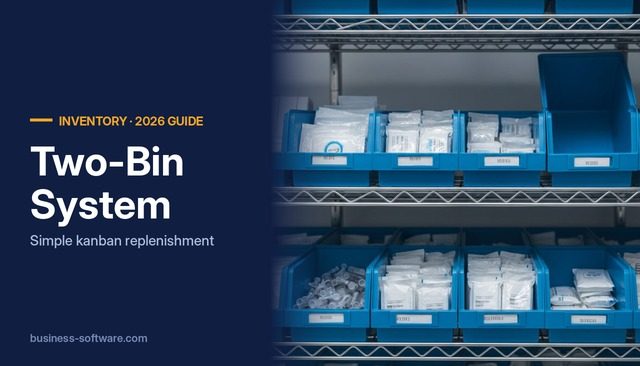
A two-bin system is a kanban replenishment method in which every stocked item sits in two containers at the point of use: you draw from the first bin, and when it is empty, the empty bin or its card becomes the signal to reorder while you work from the second bin. Each bin must hold enough to cover demand during the replenishment lead time plus a safety allowance, so the second bin never runs dry before the refill arrives. The two bin system works for factory components, maintenance spares and hospital consumables because the signal is physical, visible and triggered by actual use rather than a forecast.
The two-bin setup process at a glance
- Select the items that suit two-bin replenishment.
- Collect the data: average daily usage, replenishment lead time and pack size for each item.
- Size each bin from lead-time demand plus safety stock.
- Design the card or label and fix each item’s storage address.
- Set the signal route: who collects empty bins or cards, how often, and how the order reaches the supplier.
- Launch and train the people who consume and refill the stock.
- Audit and resize on a fixed schedule.
The Lean Enterprise Institute (LEI) defines a kanban as a signaling device that authorizes producing or withdrawing items in a pull system (LEI, May 16, 2022). In a two-bin system the empty bin, or its card, is that signal. Britannica notes the method is sometimes called the min-max system (Britannica, no date shown).
| Stage | Responsible | Accountable / consulted | Output |
|---|---|---|---|
| 1. Select items | Materials or supply chain analyst | Operations or nursing unit manager (A); users (C) | Item list per location |
| 2. Collect data | Analyst | Purchasing (C) for lead times and pack sizes | Plan-for-every-part record |
| 3. Size bins | Analyst | Supply chain manager (A) | Bin quantity and container size |
| 4. Design cards | Analyst or system administrator | Users (C) for location and wording | Printed cards and shelf labels |
| 5. Signal route | Material handler or supply technician | Supply chain manager (A); supplier (C) | Collection rounds and order cut-off |
| 6. Launch and train | Supply chain lead | Area manager (A) | Trained staff, go-live checklist |
| 7. Audit and resize | Analyst | Supply chain manager (A) | Updated quantities, retired items |
Stage 1: Select the items
The materials analyst owns this stage and turns usage history into a list of two-bin items. Good candidates are consumed regularly, are cheap to hold relative to the cost of running out, and come from a supplier with a reliable lead time. Typical examples are fasteners, maintenance filters and belts, and nursing unit consumables such as gauze and syringes.
Leave out items with lumpy, project-driven or rare demand. LEI’s account of Phase 2 Medical Manufacturing describes the company running kanban for high-volume parts and leaving MRP in place for low-volume, rarely used parts (LEI, September 23, 2016). Converting every item at once is the common failure: it doubles stock of slow movers.
Stage 2: Collect the data
For each item you need average daily usage, the full replenishment lead time and the supplier’s pack or case quantity. Lead time means the whole loop: the time an empty bin waits to be collected, order processing, supplier transit and putaway. Record it in a plan-for-every-part (PFEP) table. The Phase 2 Medical case stresses that PFEP data must be reviewed at least quarterly, because kanban often fails when the underlying data goes stale (LEI, September 23, 2016).
Check lead times against recent receipts, not the supplier’s quote. The usual mistake is to forget the internal collection delay.
Stage 3: Size each bin
Because the second bin must last until the first one comes back full, each bin should hold demand during the replenishment lead time plus safety stock. The general kanban formula used by e-kanban vendor KanbanBOX is N = D × LT × (1 + S) / C, where N is the number of cards, D is average daily consumption, LT is total replenishment time, C is units per container and S is a safety factor; its worked example (D = 100, LT = 2, C = 20, S = 10%) gives 11 cards, rounded up (KanbanBOX, April 28, 2026). In a two-bin system the number of containers is fixed at two, so you solve for container size instead: bin quantity = D × LT × (1 + S), rounded up to a whole pack.
Illustration (constructed numbers): a maintenance crib uses an average of 12 hydraulic fittings a day. Collection happens once a day and the distributor delivers in two days, so total lead time is 3 days. With a 25% safety factor, each bin needs 12 × 3 × 1.25 = 45 fittings. The fittings come in bags of 10, so you round up to 50 per bin and 100 in total.
| Input (illustration) | Value | Result |
|---|---|---|
| Average daily usage (D) | 12 units | Lead-time demand: 36 units |
| Total lead time (LT) | 3 days | Includes 1 day waiting for collection |
| Safety factor (S) | 25% | Safety stock: 9 units |
| Pack size | 10 units | Bin quantity: 50 (two bins: 100) |
Use a higher safety factor for variable demand, unreliable suppliers, or items whose shortage stops a line or delays care. Christoph Roser’s method also adds time for breakdowns to the lead time (AllAboutLean, May 11, 2014, last modified December 13, 2025). Have a second person review every quantity, and do not size to the pack instead of to demand.
Stage 4: Design the card and label
LEI lists what a kanban card typically carries: part name and number, supplier, pack-out quantity, storage address and the address of the consuming process (LEI, May 16, 2022). For a two-bin card, add a barcode that encodes the item and location, and mark the cards “1 of 2” and “2 of 2” so a missing card is obvious.
| Card field | Why it matters |
|---|---|
| Item description and internal item number | Lets the filler pick the right item without a lookup |
| Supplier and supplier part number | Prevents substitutions and wrong reorders |
| Bin quantity and unit of measure | Tells the filler exactly how much goes back in |
| Storage address (room, shelf, slot) | Returns the bin to a fixed location |
| Replenishment source and lead time | Shows whether the order goes to a storeroom, a supplier or a production cell |
| Barcode or RFID tag | Allows a scan to create the order instead of rekeying |
| Card number (1 of 2, 2 of 2) | Makes lost cards visible in audits |
Print the same layout in every area. Owens & Minor, which sells hospital supply chain services, describes hospital bins stored one behind the other, with clinicians moving the empty front bin to the top of the rack as a visual cue for materials staff (Owens & Minor, October 5, 2023).
Stage 5: Set the signal route
The material handler owns collection. Decide whether the signal is the card or the empty bin, how often the route is walked, and the order cut-off. At the University of Chicago Medical Center, clinicians placed a “Low Stock” RFID card in a holder by the supply room door when one side of a bin emptied; cards placed by 11 a.m. went electronically to Cardinal Health, and replenishment totes arrived that afternoon (NC State Supply Chain Resource Cooperative, July 10, 2013). The program covered 35,000 items, with no more than four days’ supply per bin.
The biggest risk in this stage sits upstream. LEI’s John Shook observed that many two-bin efforts look good where the material is consumed, but the signal often breaks down further back, where an IT system, a person or both override it (LEI, December 21, 2010).
Stage 6: Launch and train
Go live one area at a time. Fill both bins, attach the cards and remove hidden overflow stock, which teaches people to ignore the signal. Users follow one rule: when a bin is empty, turn in the card or bin immediately. Fillers return the full bin behind the one in use so older stock is used first.
A three-year quality improvement study in BMJ Open Quality on a medical inpatient unit reported weekly consumable costs falling from QAR 31,000 (US$8,500) to QAR 16,000 (US$4,300) after a redesigned kanban system with bins and standardized quantities, with stockouts falling to near zero and staff compliance rising from 76% to 95% (Siddiqui et al., BMJ Open Quality, November 2025). Metro, which sells hospital carts, reports a 400-bed hospital cut operating room supply checks from 18 to 20 minutes per suite to 20 to 40 seconds (Metro, no date shown).
Stage 7: Audit and resize
Bin quantities drift as usage and suppliers change. Review at least quarterly and check card counts during routine cycle counts. Watch for bins that are always nearly full (oversized) and second bins that are opened often before the refill arrives (undersized).
LEI coach Michael Ballé takes a stricter view: he recommends reviewing each supermarket monthly and using it to drive improvement, deliberately removing cards to expose problems rather than simply recalculating quantities (LEI, October 28, 2013). Record every change so the card, label and system record agree.
When a two-bin system beats MRP
MRP plans purchases from a forecast and a bill of materials. A two-bin system reacts to actual consumption, which LEI describes as replacing only what the following process has withdrawn (LEI, July 2, 2020). Two-bin control usually wins for cheap, frequently used items with steady demand, for maintenance spares with no bill of materials, and for clinical consumables. MRP fits expensive, long-lead or order-specific parts better.
Most manufacturers run both. The Phase 2 Medical example used kanban for high-volume parts and MRP for low-volume ones, and connected the PFEP to the ERP so kanban parameters were recalculated when demand changed (LEI, September 23, 2016). Our guide to MRP and kanban covers the push versus pull decision in more depth.
Metrics to track
- Stockouts: times both bins were empty, per item and area (hospitals often report per 1,000 patient days).
- Second-bin openings before refill: an early sign of undersized bins.
- Signal-to-refill time, compared with the lead time used for sizing.
- Inventory value and turns against the pre-launch baseline.
- Card accuracy: cards found against cards issued during audits.
- Compliance: share of audited bins correctly placed and carded.
How software supports each stage
A paper two-bin system needs no software, but ERP and inventory tools help with sizing, card printing and turning a scan into an order.
- Microsoft Dynamics 365 Supply Chain Management: fixed-quantity kanban rules keep a constant number of kanbans in circulation, and a kanban quantity calculation job sets that number from demand and a service factor (Microsoft Learn, updated June 11, 2026). The kanban transfer board accepts a barcode scan of the card to start, complete or mark a handling unit as empty (Microsoft Learn, updated July 1, 2026).
- SAP S/4HANA: kanban control cycles carry a calculation profile with a safety factor, and the Kanban Calculation app proposes container counts or quantities. Barcode scans set container status, and cards print through the Collective Kanban Print app (SAP Learning, no date shown).
- Oracle Fusion Cloud SCM: a pull sequence holds the source type, kanban size, number of cards and lead time, and generates printable cards (Oracle, Release 25D, September 24, 2025). The page does not state a sizing formula, so you set the size yourself.
- Microsoft Dynamics 365 Business Central: its reordering policy documentation does not mention kanban, but a Fixed Reorder Qty. policy with a reorder point that “represents demand during lead time” plus safety stock reproduces two-bin logic in the planning engine (Microsoft Learn, June 12, 2024).
- Dedicated e-kanban and hospital tools: KanbanBOX sells e-kanban software that says it integrates with ERP systems and sends replenishment orders automatically (KanbanBOX, April 28, 2026). BlueBin, a hospital two-bin provider, says a single scan of a bin can send a fill order to the manufacturer or distributor; it publishes savings claims but no pricing (BlueBin, September 30, 2026).
If you are comparing reorder-point, min/max and kanban tools more broadly, see our guide to inventory replenishment software.
How we researched this
We read the pages that rank for “two bin system” today (vendor guides from ShipBob, Owens & Minor and Metro, and the Velaction glossary); none gives a sizing method, a card specification or a view of ERP support. We then used Lean Enterprise Institute lexicon entries and Lean Post articles, a peer-reviewed BMJ Open Quality study, an NC State case write-up and vendor documentation from Microsoft, SAP and Oracle, checked on October 9, 2026. Agency for Healthcare Research and Quality (AHRQ) Lean case study pages did not load for us, so we have not cited them. Where a source sells a product, we say so.
Related guides
- VMI Software: How Suppliers and Distributors Run It
- Bin Location System: How to Set Up Warehouse Locations
Frequently asked questions
What is a two-bin system in inventory?
A two-bin system is a kanban method that stores each item in two containers at the point of use. When the first bin is empty, it or its card triggers a reorder, and you use the second bin until the refill arrives. Each bin holds enough to cover demand during the replenishment lead time plus safety stock.
How do you calculate the size of each bin?
Multiply average daily usage by the total replenishment lead time in days, add a safety factor, and round up to a whole pack. For example, 12 units a day with a 3-day lead time and a 25% safety factor gives 45 units, which becomes 50 if the item comes in packs of 10. Include the time an empty bin waits to be collected in the lead time.
Is a two-bin system the same as min/max?
They follow the same logic. Britannica notes that the two-bin system is sometimes called the min-max system. In both methods, a fixed reserve quantity acts as the reorder point. The difference is that a two-bin system makes the trigger physical and visible, while a min/max rule in software needs an accurate on-hand balance to fire.
Can I run a two-bin system in my ERP?
Dynamics 365 Supply Chain Management, SAP S/4HANA and Oracle Fusion Cloud SCM support kanban natively with printable cards, and the Microsoft and SAP systems also accept barcode scans. Smaller systems such as Business Central can mirror the logic with a reorder point and safety stock.
Sources
- Lean Enterprise Institute, “Kanban,” Lean Lexicon entry, May 16, 2022
- Lean Enterprise Institute, “Fill-Up System,” Lean Lexicon entry, July 2, 2020
- Chet Marchwinski, “Manufacturing Balancing Act: Pull Versus ERP,” Lean Enterprise Institute, September 23, 2016
- John Shook, “A Fundamental Question,” Lean Enterprise Institute, December 21, 2010
- Michael Ballé, “How do I re-size supermarkets when demand changes or to keep pace with seasonality?” Lean Enterprise Institute, October 28, 2013
- Britannica, “Two-bin system”, no date shown
- Siddiqui R., Logrono K.J., Zu’bi B.S.M., “‘Leanomics’ in healthcare,” BMJ Open Quality 14(4), DOI 10.1136/bmjoq-2025-003416, November 2025
- NC State Supply Chain Resource Cooperative, “Using RFID two-bin kanban at the University of Chicago Medical Center”, July 10, 2013
- Owens & Minor, “Kanban: a simple, effective solution to consumable supply management in the hospital” (vendor), October 5, 2023
- Metro, “Hospital Becomes ‘Lean’-er with a New Two-Bin Kanban System” (vendor), no date shown
- KanbanBOX, “How to Calculate the Number of Kanban Cards” (vendor), April 28, 2026
- Christoph Roser, “How Many Kanbans? The Kanban Formula, Part 2,” AllAboutLean, May 11, 2014 (last modified December 13, 2025)
- Microsoft Learn, “Create and process fixed kanbans in Dynamics 365 Supply Chain Management”, updated June 11, 2026
- Microsoft Learn, “Kanban transfer board support for barcode scanners”, updated July 1, 2026
- SAP Learning, “Configuring General Settings for Kanban”, no date shown
- Oracle, “Define Pull Sequences and Generate Kanban Cards,” Release 25D, September 24, 2025
- Microsoft Learn, “Design details: Handling reordering policies,” Business Central, June 12, 2024
- BlueBin, “2-Bin Kanban System for Hospitals” (vendor), September 30, 2026

Sherman Hsieh
Independent analysis of enterprise software — ERP, CRM and more