
Application Development Software
Research and reviews for ALM software
-
About Application Development Software
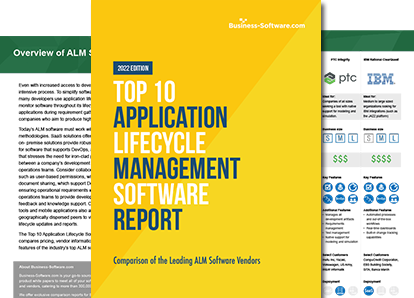
ALM software helps businesses more effectively manage end-to-end software development, implementation, usage and improvement. An application lifecycle management solution streamlines the software creation process, allowing companies to save time and money and better address customer needs. Browse the best business ALM software with Business-Software.com’s free comparison report of the Top 10 Application Lifecycle Management Software solutions. Any business that develops software applications will benefit from implementing ALM software, with market-specific products available for defect tracking and QA testing alike. Among the top-rated ALM software products are:- TechExcel Dev Suite
- SmarteSoft SmarteQM
- Borland Silk Central
- SmartBear ALM Complete
Articles
-
ALM Software Reviews
ALM Software Reviews Articles

Buying ALM in 2014: The Features You Need
By
To ensure your application is well nurtured and high-performing, Application Lifecycle Management software (ALM) serves as an essential tool for every event of an application’s life. To make sure your application has its essential needs met, here are the features you need when buying ALM in 2014.
Let's Talk RhoMobile: Behind the Software Q&A with Motorola Solutions
By
Business-Software.com had the pleasure of speaking to Mark Kirstein, Motorola Solutions' Senior Director of Project Management solutions, about the rapid evolution both RhoMobile and Motorola Solutions undertake. We talk about the new developer-centric world, the internet-of-things future, and the complexities of building business software.
Let's Talk Serena Software: Q&A with Senior VP David Hurwitz
By
Serena Software revolutionized the app development lifecycle with the DevOps approach. We talked to Senior VP David Hurwitz about what the DevOps revolution means for the top application development software, and how Serena is staying a step ahead of the competition.

Evaluating The Amazon Alexa Developer Platform
By
Recent developments in technology have been focusing more and more on the user experience part of it. A lot of research is being done by the likes of Google, Amazon and Microsoft in this area. The problem they are trying to solve is to reduce the threshold energy a user ... (more)
-
Tips for Managing the Application Lifecycle
Tips for Managing the Application Lifecycle Articles

Waterfall vs. Agile Development: How They Differ and Why it Matters
By
Like Red Sox and Yankees fans or Republican or Democrat parties, waterfall and agile represent two different philosophies, each with its own beliefs and values. While both methods have proven successful, developers often have a clear opinion on which is best. To choose the best ALM software for your company, look for application development software that supports your team's methodologies.

Why Vendor Timeliness Matters to Your Company
By
Nothing worse in today’s fast-paced world than letting a decision fester while waiting for a new product to arrive or a new service to be implemented. Quick and dedicated service after the purchase agreement is made is a must. Yet that’s not always how it happens. For your project to be successful, vendors need to be dedicated to doing the work they promised in the timeline they promised.

Understanding the Benefits of Integrating Automated Testing with DevOps
By
Across software projects, DevOps is becoming a major asset for turning out products that not only have limited bugs, but will also be effective for user needs. Read on to learn about the benefits of integrating automated testing with DevOps and how to choose when to begin automating.

3 Steps to Transform into a Mobile Application Developer
By
Do you have the skills to be a full-fledged mobile application developer, maintaining your desktop development chops along the way? Maybe not. That's why we're here to help.
-
Top QA Testing Software
Top QA Testing Software Articles

Overcome 4 QA Challenges with Test Management Software
By
Test management software is a major resource for any organization that wants to improve its quality assurance processes as well as the overall quality of its software. As central platforms for software testing and other related tasks, these resources can help team leaders address many common QA challenges.

The 2014 Top 5 QA Testing Software Solutions
By
Explore these top 5 QA testing solutions to find the product that is best for your development team, whether you work with Agile or Waterfall workflow methods.
Behind the Software Q&A with Zephyr CEO Samir Shah
By
We spoke with Zephyr CEO and co-founder Samir Shah about how Zephyr, with its deep integrations with top products, is the only real-time test management tool that can handle the needs of agile development teams.

3 Benefits of Using Quality Management Software
By
If you had a tool that could improve your business, would you use it? Quality management software can simplify compliance issues, provide necessary project management tools and improve security and scalability for your company.
-
View All Blog Posts
Top Application Development Blog Posts

Local Tech Series: Sydney, Australia
By
Tech hubs can be like gardens — sometimes they explode into jungles all on their own and sometimes they need someone to create the ideal environment in which to take root. In 2015, New South Wales Premier, Mike Baird, announced that Australia’s Industrial Bays Precinct was next in line to become one such environment — turning a formerly disused area into an established support base for tech startups, incubators and accelerators.
Popular Application Development Solutions

Siemens Polarion ALM
Polarion ALM is an ALM software solution that provides complete project transparency and gives users a solid collaboration platform. The program works from source code to production and enforces compliance every step of the way.

CollabNet VersionOne TeamForge
TeamForge is application lifecycle management software designed to support collaborative software development, as well as ensure governance, compliance and code security standards. The platform supports Agile, continuous integration and continuous delivery processes, as well as provides end-to-end visibility, traceability and reporting.

Atlassian Jira Software
Jira Software is an application lifecycle management software for teams who are planning, developing and launching a product. The platform allows users to work with powered product teams including Facebook, Microsoft, Hulu, Cisco and LinkedIn using a clean interface and code integration tools.

- SmartBear ALMComplete
SmartBear ALMComplete is an ALM software solution that uses collaboration to help keep team members organized. At the start, users can enter in projects, assign tasks to different works and prioritize project needs. Users can then share documents with one another, test different builds and compile lists of defects.

PTC Integrity
PTC Integrity is a software system lifecycle management solution that coordinates all development methods and manages all development pieces.
IBM Rational Clearquest
IBM Rational Clearquest is database workflow application development software that provides companies with built-in change and defect tracking tools and allows users to customize processes. The platform is equipped with lifecycle traceability and system visibility, multi-platform support and workflow automation capabilities.