
IT Management Software
Research and reviews for IT management software
-
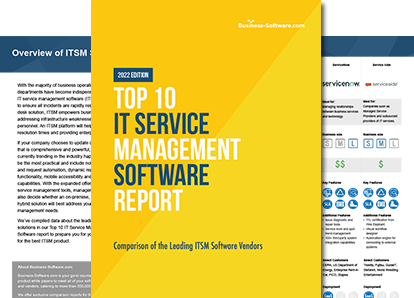
Ready to find a top-rated ITSM solution for your business?
Let us help you.
Download Free ReportAbout IT Management Software
IT management software unifies many disparate and specialized elements of the corporate IT ecosystem under the umbrella of several types of software solution. The rapid proliferation of commercial IT trends like BYOD and the cloud have opened up both potential IT risks, like security breaches, and benefits like greater cost savings. Browse the best business accounting software with Business-Software.com’s free comparison report of the Top 10 IT Service Management software solutions. The types of products classified under IT management range from broader IT infrastructure monitoring and asset management to more specialized solutions like email security and mobile device management (MDM). Among the top-rated IT management software products are:- ChangeGear Enterprise Service Desk
- Remedyforce
- FrontRange IT Asset Management
- LANDesk Asset Lifecycle Manager
Articles
-
Cloud IT Management
Cloud IT Management Articles

CloudPassage Delivers Elastic Security in a Dynamic Cloud
By
Cloud computing has dramatically changed the way organizations approach security. CloudPassage co-founder and CEO Carson Sweet explains how Halo can deliver scalable, elastic security in public and hybrid cloud environments, and how it bridges the gap between traditional data center security and security in dynamic cloud environments.

Does Your Company Need Cloud Quality Management Software?
By
Does your business need a new cloud-based QMS software solution? We uncover what features your company should look for in a quality management solution.
Behind the Software Q&A with Midokura CEO Dan Mihai Dumitriu
By
MidoNet, the flagship product from vendor Midokura, is a network virtualization system with a distributed architecture that simplifies and stabilizes your system network. In this exclusive Q&A with Midokura CEO Dan Dumitriu, we talk about MidoNet's value as a virtual network provider and the importance of scalability in network virtualization.

4 Key Features of Remote Support Solutions (And Where to Find Them)
By
Remote support solutions can make a huge different to IT staff members and customer service agents, enabling them to provide the best technical support to both employees and customers. Here are the must-have features (and the products that offer them) you'll want to look for!
-
IT Security Software
IT Security Software Articles

Why BYOD Is Like Cancer (And How Endpoint Security Is the Cure)
By
Despite its rapid adoption, BYOD complicates endpoint security. Each phone, laptop and tablet connected to your network acts as another cancerous cell, growing your security risk and making your business susceptible to viruses and hacks. When unable to control devices outside of the workplace, employees can leave company information exposed or use non-approved applications that pose a threat to the business.

The Top 10 Antivirus Software Tools in 2014
By
Responding to these concerns, the major antivirus producers have put out their 2014 editions with many updated features to help your business stay ahead of the hackers. Here’s our list of the top 10 antivirus software available in 2014:
Behind the Software Q&A with LogicMonitor CEO Kevin McGibben
By
Just because network stacks continue to get more complex doesn't necessarily mean that the means to monitor them properly have to get just complicated. LogicMonitor operates on that principle, offering dynamic stack monitoring based on a simple Java-based application that can be installed on any device. In this second part of our feature on LogicMonitor we talked to CEO Kevin McGibben to find out more about the company and what it's setting out to do with the product.

4 Tools Healthcare Companies Need in Their Digital Security Arsenal
By
As a healthcare provider serving consumers in our technology-driven age, you must also protect the sensitive data that you’re entrusted with. We’ve outlined a variety of security software tools that can help you do just that, whether you’re a medical office, hospital, insurance provider, rehab center or pharmaceutical company. Use our list as a starting point to identify and correct any weak spots in your security processes.
-
IT Service Management
IT Service Management Articles
Why and How to Use ITIL to Standardize Processes across the Enterprise
By
With the expansion of the ChangeGear platform to include fully customizable modules, SunView Software is helping companies integrate their line of business processes with the ITIL-based framework. The modules have customizable workflow to match existing processes outside of the IT Organization helping to better align the business through standardization of practices.

Behind the Software Q&A with Plutora Co-Founders
By
Australian startup Plutora is revolutionizing the release management industry by shifting the focus to end-to-end release management obligations and customer needs. We spoke with Directors Sean Hamawi and Dalibor Siroky about their relocation to the US and commitment to bringing simplicity and transparency to the now-complex space.

ITIL Course: Service Catalog 101
By
Welcome to the ITIL Class on Service Catalog. Over the course of this article, you will gain a better understanding of the function of a service catalog and the effort required to build one.

The Implementation of an ITIL-as-a-Service Essentials Solution
By
The most basic way to get started with ITIL in your IT organization is the ChangeGear “ITIL-as-a-Service” essentials solution. There are five minimum components that we recommend in order to start an ITIL implementation: Incident Management, Problem Management, Change Management, Service Catalog, and Service Asset & Configuration Management.
-
Mobile Device Management
Mobile Device Management Articles

The Key Features of Mobile Device Management
By
Mobile devices are the future. For most, a mobile strategy will undoubtedly be crucial for companies who don’t wish to be left behind. Below, we've compiled the key features of mobile device management in order to give business owners a better idea of what to look for when choosing a solution for their business.

MDM vs. EMM Software: Decoding the Acronyms
By
MDM software can keep your company's mobile devices safe. Yet an EMM software suite offers more comprehensive solutions for end-to-end mobility management.
5 MDM Solutions to Help Your Company Handle BYOD Mania
By
It’s official -- business operations have gone mobile, and with them classified company data. Despite its convenience, BYOD poses a very large, very real threat to the security of businesses migrating to this modern workspace. That’s where mobile device management software, or MDM, comes in.

Mobile Business Apps are Great, But What About Security?
By
Mobile business apps have made progress in leaps and bounds the past few years. Unfortunately, another thing that's been opened up is the vectors of attack for security risks both unintentional and malicious. Here are some of the gaps in which security risks might throw a monkey wrench or two into your mobile apps policy.
-
Trends in IT Management
Trends in IT Management Articles
A Closer Look at the Consumerization of IT
By
The consumerization of IT does not refer to a particular technology or software; instead, it refers to the use of consumer technologies and devices, such as iPhones, iPads, and other mobile devices within the enterprise. More than another industry buzzword, the consumerization of IT is changing the way employees work and the role of IT within the enterprise.

What Is Network Management Software?
By
In a nutshell, network management software is a platform that uses tools and functions to operate, administrate and maintain your computer network systems. We explain more and share the benefits of implementing such a platform in this in-depth introduction.

Lessons from Heartbleed: 3 Data Security Takeaways
By
While Heartbleed has caused quite a stir over the past few weeks, the exploit has also revived an important discussion about how businesses and websites handle and protect sensitive information and data. Data security has become an increasingly important concern for today's business owners.
IT Buzzwords You'll Hear in the Boardroom in 2013
By
Not all tech buzzwords are fluff, but most of them are. In this article we explore some of the IT management buzzwords that will be flying past your head in the boardroom in 2013.
- View All Blog Posts
Popular IT Management Solutions

Ivanti HEAT IT Service Management
HEAT IT Service Management is ITIL service management software that provides release management, service level management, event management, availability management, financial management, and portfolio and project management tools. The platform enables users to automate incident processes, identify problem sources and restore service operations.

SunView Software ChangeGear Enterprise Service Desk
The ChangeGear Enterprise Service Desk is a web-based IT Service Management (ITSM) software solution that enables IT organizations to efficiently resolve IT requests and track, manage, and control IT services. ChangeGear includes the seamless integration of key ITSM processes: Incident Management, Problem Management, Change Management, Release Management, and Knowledge Management.

Zetta DataProtect
Zetta DataProtect is an enterprise cloud backup solution that is able to store up to 5 terabytes of backup data in 24 hours. The solution reliably supports organizations such as Marketo, UCLA and Mint by providing 3-in-1 backup in local, offsite and remote replication for instant or disaster recovery. All files are in its proprietary format and replicated without compression.

Asigra Cloud Backup
Asigra Cloud Backup is an enterprise-grade cloud backup and recovery solution that provides an integrated approach to data protection. The solution performs fast, efficient and secure backups of all types and locations of data, including physical and virtual environments, endpoint devices, data in cloud-based applications and more. The single, integrated platform protects against all data loss scenarios in the user's environment.
Netop Remote Control
Netop Remote Control has been serving major enterprises spanning industries and political boundaries for nearly 30 years. The solution excels in complex global environments where efficiency, stability and security are paramount.

CA Technologies IT Service Desk Manager
CA Technologies IT Service Desk Manager is an IT help desk solution that helps businesses provide quality, consistent IT service support to their employees. This IT service desk solution affords visibility into a company’s IT infrastructure so that problems can be identified and corrected before they disrupt operations.