
Business Intelligence Software
Research and reviews for business intelligence software
-
Looking for business intelligence software?
Compare leading solutions now.
Download NowAbout Business Intelligence Software
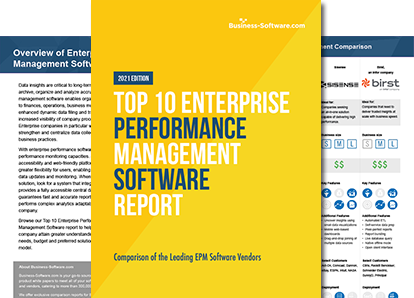
Business intelligence software is a critical tool for any business looking to harness their data and more accurately detect and evaluate structural patterns, anticipate trends and achieve increased operational visibility. Browse the best business intelligence software with Business-Software.com’s free comparison report of the Top 10 Business Intelligence solutions. The benefits of business intelligence gathering can be realized most fully by large enterprises, but even smaller businesses can benefit from the insights brought by business intelligence systems. Among the top-rated BI software products are:- SAP BusinessObjects
- Domo Business Intelligence
- Oracle BI Foundation Suite
- Birst
Articles
-
BI Software Vendors
BI Software Vendors Articles

SAP BusinessObjects vs. Oracle Business Intelligence
By
With these SAP and Oracle so clearly dominating the BI segment, a logical question—and one that we’ve seen before in the Business-Software.com Community—is how do SAP BusinessObjects and Oracle Business Intelligence Enterprise Edition compare?

Top BI Solutions for Small Business
By
For a while, business intelligence software was too expensive and too complex to meet the needs of small businesses. Today, thanks in part to cost savings afforded by the cloud, there are a host of BI solutions available to help small businesses visualize, analyze, and report on their complex data.

4 BI Vendors Using Impala to Supercharge Hadoop
By
As a distributed file system for organizing and analyzing big data (think pedabytes), Hadoop has a lot of things going for it: affordability, scalability and flexibility to name a few, yet it's far from perfect.

Splunk Makes Sense of Machine Data
By
San Francisco-based Splunk is a leading solution for monitoring, searching, and analyzing machine data, and the company’s vast client list and impressive IPO earlier this year are a testament to the importance of harnessing machine data. We review this top Big Data software solution.
-
Big Data Software
Big Data Software Articles

Top 10 Most Effective Ways to Visualize Your Business Data
By
Due to the amount of data businesses need to parse through and act on every day, the data visualization market is growing at unprecedented rates. And businesses of all sizes from all sorts of industries are acquiring data visualization softwarein droves (International Data Corporation). Unfortunately, simply acquiring and implementing a ... (more)
Behind the Software: Q&A with EverString CEO Vincent Yang
By
We spoke with CEO Vincent Yang in this exclusive Q&A with EverString to learn about how the company came to be and how they will play a vital role in the predictive analytics industry.

Close More Deals with Data Visualization Software
By
Whether you’re a small business or a large enterprise, data visualization solutions will change the way you see data---literally. We uncover the top benefits you could receive, and offer four practical applications for using data visualization software.

Let's Talk Continuuity: Behind the Software Q&A with CEO Jonathan Gray
By
We spoke with Continuuity CEO Jonathan Gray about how in its short period of existence the company has drastically altered the Big Data industry, constructing a Platform-as-a-Service (PaaS) Hadoop framework designed by developers, for developers.
-
Business Process Management
Business Process Management Articles
Business Process Management 101
By
BPM can be thought of as being related to business intelligence and operational intelligence solutions. With this actionable information in hand, key stakeholders within an organization can understand the relationship between processes and model them out, gaining visibility into key areas and finding opportunities for improvement.
BonitaSoft and the Democratization of Open Source Business Process Management
By
Business Process Management (BPM) software has typically been seen as the domain of huge developers like IBM and Oracle and the huge enterprises who can afford their solutions. BonitaSoft contends, however, that the benefits of BPM can extend to small and medium-size businesses too, and they know how to do it. We spoke to BonitaSoft vice president of marketing Mac McConnell to find out more about how open source--and a highly competitive price point--are helping in its goal of democratizing BPM.
Top 10 Most Effective Ways to Visualize Your Business Data
By
Due to the amount of data businesses need to parse through and act on every day, the data visualization market is growing at unprecedented rates. And businesses of all sizes from all sorts of industries are acquiring data visualization softwarein droves (International Data Corporation). Unfortunately, simply acquiring and implementing a ... (more)
![Run Your Business On Open Source Software [Infographic]](https://1e1851c3a3519282423c-9ba0ce2ac411d9ff878c3235c5043bea.ssl.cf1.rackcdn.com/post/open-source-t.jpg "Run Your Business On Open Source Software [Infographic]")
Run Your Business On Open Source Software [Infographic]
By
Whether you seek a single open source platform to test the waters or are interested in running many of your core business processes with open source tools, we're here to help! Use our snazzy infographic to learn how you can run your essential company operations with open source software.
-
Trends in BI Software
Trends in BI Software Articles

How In-Memory Data Grids Differ from Spark and Storm
By
We provide a deeper understanding of in-memory data grids (IMDG) and how they differ from popular open source solutions like Spark and Storm.

You Should Know Why Alphabet Acquired These 3 Companies
By
Companies acquiring other companies is a large component of capitalism and is necessary when trying to maintain a competitive environment. One such business that has gained fame through just buying other businesses is Alphabet, Google’s parent company. Company buyouts are becoming more and more common and most people other than investors, don’t pay attention. However, a company as large and impactful as Alphabet, everyone should be watching their every move. Recently, the tech giant acquired three companies: Webpass, Moodstocks and Anvato and people should know what’s going on.
Close More Deals with Data Visualization Software
By
Whether you’re a small business or a large enterprise, data visualization solutions will change the way you see data---literally. We uncover the top benefits you could receive, and offer four practical applications for using data visualization software.

The Cortana Analytics Suite and the Future of BI Software
By
Microsoft’s new Cortana Analytics Suite joins together -- and attempts to streamline -- many formerly disparate data processes: data storage, machine learning, big data analytics, information management and business intelligence. Let's take a look which existing Microsoft services will play a part in the new analytics suite, what functionality each brings to the table, and what this means for the future of BI software.
- View All Blog Posts
Popular Business Intelligence Solutions

Salesforce Analytics Cloud
The Salesforce Analytics Cloud is a business intelligence and analytics software platform that allows business users and teams to easily filter, measure, group and share datasets. Self-service capabilities enable users to instantly access data and customize dashboards without assistance from IT or analysts.

Birst
Birst Networked approach to BI and Analytics enables a single view of data, eliminating data silos. Decentralized teams and individual users can augment the corporate data model with their own local data, without compromising data governance. Consistency comes from a unified semantic layer, which maintains common definitions and key metrics, no matter where users sit.

Domo Business Intelligence
Domo is a cloud-based executive management platform that is redefining the business intelligence market and transforming the way business is managed.

Sisense
Sisense offers any sized business the chance to generate high-quality business intelligence without hardware-intensive applications, IT specialists, prior programming knowledge or prior BI experience.

Tableau Server
Tableau Server is business performance management software that provides users with interactive system insights without the limits that come with pre-defined questions, wizards or established chart types. The platform connects to any data source, allows users to publish and share data sources in order to enable team-wide access, and works with multiple third-party enterprise data sources including Cloudera Hadoop, Oracle, and AWS Redshift.

QlikView
QlikView Business Discovery platform does away with expensive and outdated business intelligence systems that constrain the end user’s analytic creativity. Instead, this top business intelligence tool leverages the power of patented, in-memory cloud technology to aggregate, organize and present data to employees throughout the organizational hierarchy.